From Other Sources · Leadership & Work
Cognitive Biases: A Cheat Sheet for Better Decisions
Shared from Ashley Nicholson on LinkedIn
See the original post (11 July 2024)
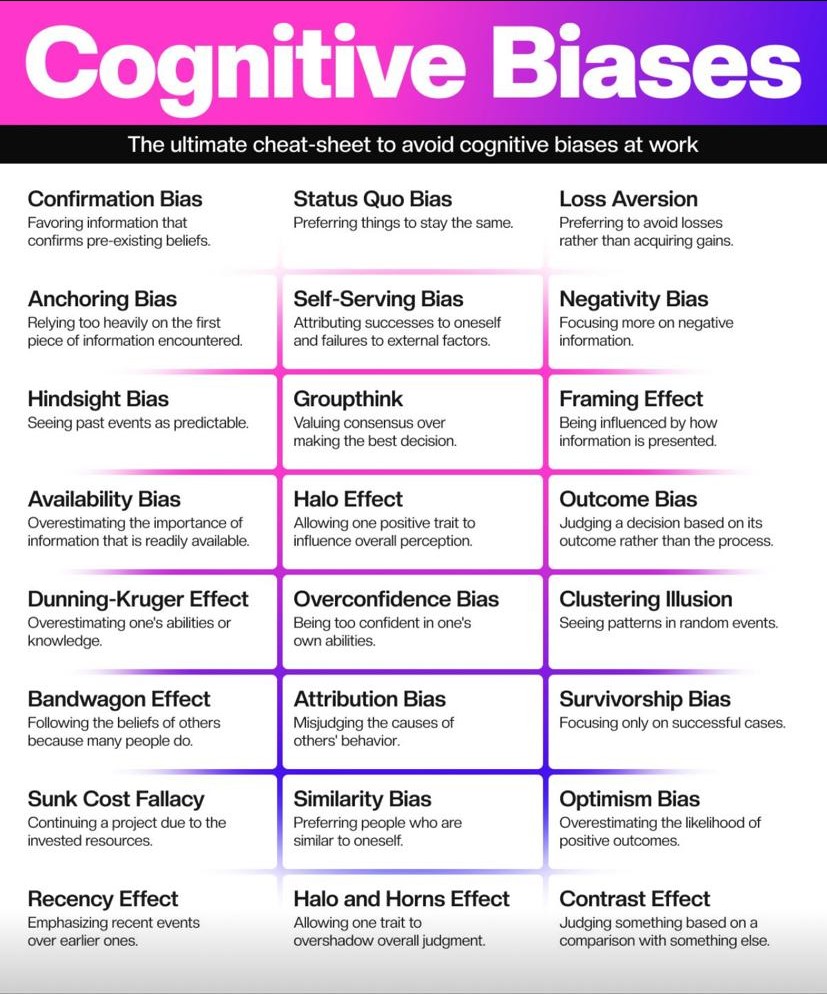
The picture in words
A three-column grid of 24 cognitive biases, each given a name and a one-line definition.
Twelve are defined in the text. The other twelve are loss aversion; overconfidence, attribution, similarity, negativity, outcome, survivorship and optimism bias; the framing and contrast effects; the halo and horns effect, where one trait colours the whole judgement; and the clustering illusion, finding patterns in randomness.
How to make better decisions.
Avoid these 24 cognitive biases (you'll thank me later):
1/ Confirmation Bias: Favoring information that confirms pre-existing beliefs.
2/ Anchoring Bias: Relying too heavily on the first piece of information encountered.
3/ Hindsight Bias: Seeing past events as predictable.
4/ Availability Bias: Overestimating the importance of information that is readily available.
5/ Dunning-Kruger Effect: Overestimating one's abilities or knowledge.
6/ Bandwagon Effect: Following the beliefs of others because many people do.
7/ Sunk Cost Fallacy: Continuing a project due to the invested resources.
8/ Recency Effect: Emphasizing recent events over earlier ones.
9/ Status Quo Bias: Preferring things to stay the same.
10/ Self-Serving Bias: Attributing successes to oneself and failures to external factors.
11/ Groupthink: Valuing consensus over making the best decision.
12/ Halo Effect: Allowing one positive trait to influence overall perception.
13/ Overconfidence Bias: Being to …
Source: Ashley Nicholson on LinkedIn — view the original post.