From Other Sources · Mind & Emotions
How to Become a Critical Thinker
Shared from Vaughan Broderick on LinkedIn · via Gav Blaxberg
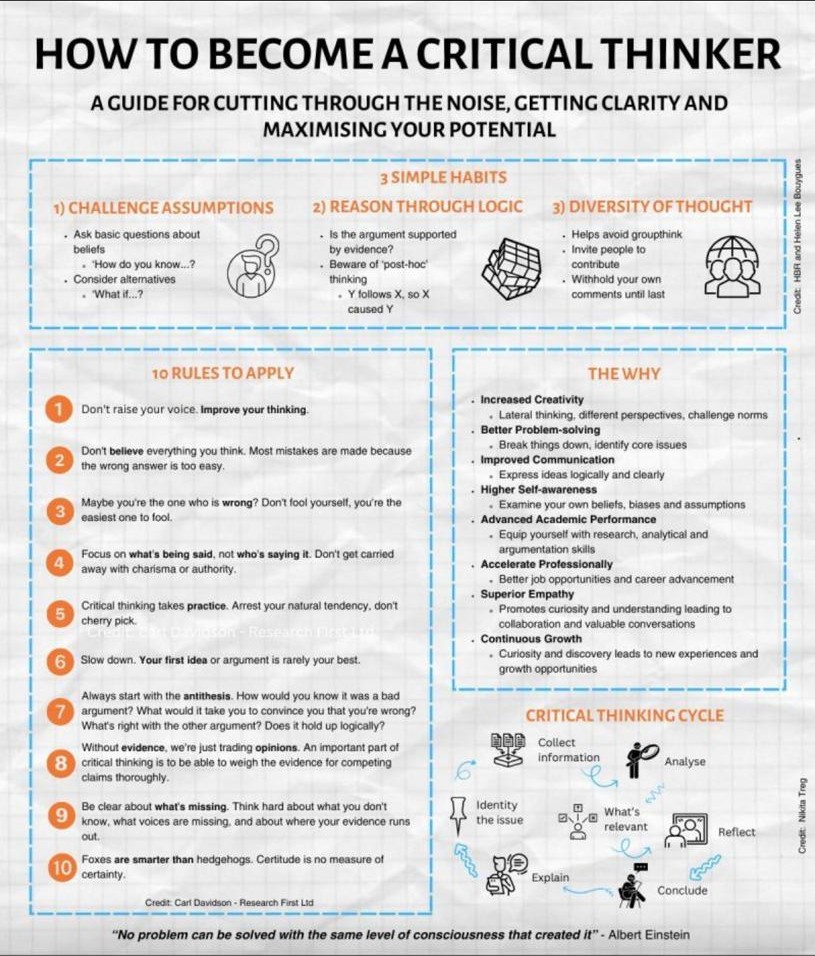
The picture in words
Four panels make up the guide:
- The three habits listed in the text, credited to HBR and Helen Lee Bouygues, with prompts: ask how you know, check the evidence, beware false cause, and let others speak first.
- Ten rules credited to Carl Davidson of Research First, such as distrusting your first idea, judging the argument not the speaker, starting from the opposing case and asking what is missing.
- The why: eight benefits, among them creativity, problem-solving, clearer communication, self-awareness, career progress and empathy.
- A seven-step cycle credited to Nikita Treg: identify the issue, collect information, analyse, pick out what is relevant, reflect, conclude and explain.
The Einstein quotation given in the text runs along the bottom.
Mass information is blasting you daily.
How do you make sense from the noise?
That's where critical thinking comes in.
What's great, is that it's an valuable skill no matter the job or situation.
And, it's something that only comes with practice.
Carl from Research First opened my eyes to a way of thinking about thinking.
Since then, it's been a daily work on.
That's the point, it's a muscle you need to constantly exercise to get the best.
Just starting out?
Try these 3 steps:
- Challenge your assumptions
- Reason through logic
- Leverage diversity thoughts
There's much more in the guide to explore.
I hope it helps you.
Happy weekend.
“No problem can be solved with the same level of consciousness that created it” - Albert Einstein …
Source: Vaughan Broderick on LinkedIn (shared via Gav Blaxberg).