From Other Sources · Mind & Emotions
48 Questions for Critical Thinking
Shared from Justin Wright on LinkedIn · via The Emotional Intelligence Network
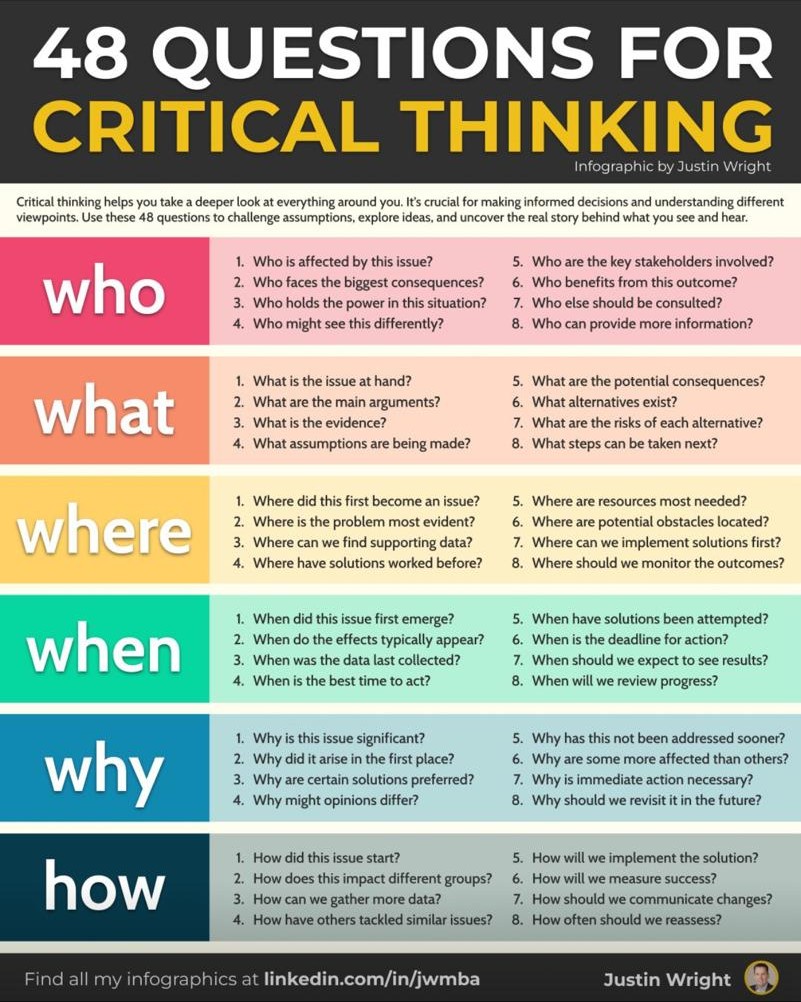
The picture in words
Six colour-coded bands hold the questions, introduced as a way to test assumptions and find the real story.
- Who: who is affected, gains or holds power, who sees it differently, and who else to consult.
- What: the issue, arguments, evidence, assumptions, consequences, alternatives and their risks, and next steps.
- Where: where the problem began and shows most, where data and resources are, and where to act and monitor.
- When: when it began, how recent the data is, deadlines and timing, and when to expect results and review.
- Why: why it matters and arose, why opinions differ, and why act now or revisit later.
- How: how it began and affects groups, gathering data, implementing and measuring a solution, and reassessing.
Critical thinking and emotional intelligence go together.
Both are rare.
Both are valuable.
Both can be learned.
But what exactly is critical thinking?
In simple terms, it means:
- Closely analyzing information to form a judgment
- Questioning what you see, hear, and read
- Not just accepting things at face value
Why is this important?
Because it helps you:
- Make better decisions
- Solve problems more effectively
- Avoid being misled by false information
How does it relate to EQ?
Emotional intelligence helps you:
- Understand the feelings behind the facts
- Recognize your biases, and those of others
- Communicate your thoughts clearly and kindly
In today's complex world, we need both skills.
Critical thinking sharpens your mind.
Emotional intelligence opens your heart.
Combined, they're a powerful tool.
How can you improve these skills?
- 1/ Start by asking questions.
About facts. About feelings.
- 2/ Practice active listening.
Try to see other perspectives.
- 3/ Challenge your own assumptions.
T …
Source: Justin Wright on LinkedIn (shared via The Emotional Intelligence Network).